
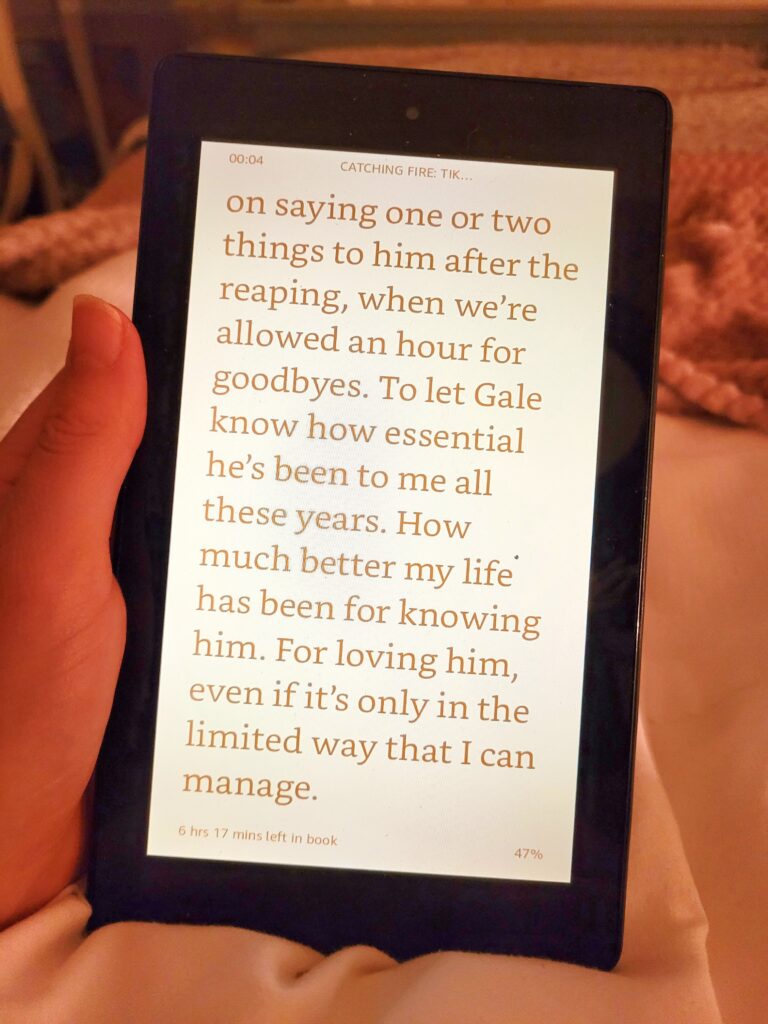
Do you enjoy having days or nights where you are able to just get cosy and curl up somewhere in order to get lost in a good book?
As a child, I loved reading. Recently, my mum was doing a big sort out, taking a load of old things to the charity shop, when I came across a lot of my old books. I had a series of fairy and animal books which I adored back when I was in Primary school. I also came across some beautifully illustrated story books.
I found these children’s books to have quite a good font size for me. The font of children’s books tends to be quite a bit bigger than adult fiction, with the font often also being in a more bold font.
How my vision impacted my enjoyment in reading.

Sadly, by secondary school (age 11+) I tended to not do a lot of reading. The kind of books which I wanted to read no longer were originally published in as much of a comfortable font as children’s books were.
I can technically hold a normal font sized book really close and read it, but after a few minutes, with my eye condition (Nystagmus) it becomes very taxing on my eyes, making them feel sore.
This should not be a reason for people with vision impairments to not be able to be included in the book community.
Thankfully, we live in a time where we do not need this barrier as there are multiple options out there.
Some reading options out there for blind/ partially sighted people.
A few years ago, I found that Amazon has a lot of the well-known novels available as large print versions. I found this really useful at school for my English Literature classes, as the Amazon versions often looked the same as the normal version which other students were reading, but just slightly bigger and with more pages due to the bigger font.
Guide Dogs UK also offers tailor-made books for children and young people. On their website, you can choose the book and select lots of options such as font size, font style, page colour and more. I don’t know if this service was around when I was young enough to have benefited, but I definitely think it is an amazing idea now for anyone who has a child with a vision impairment. Alternatively, if you are a parent with a vision impairment who wants to be able to read stories to their child.
If reading text isn’t an option for you, in the UK, the RNIB (Royal National Institute of Blind People) also has a service where you can purchase books in the format of braille.
The magic of eBooks and audiobooks.

This is an area where me and a friend of mine with Nystagmus differ. Both of us are into reading, however, while my favourite way to read is using the Amazon Kindle, she personally desires the tangibleness of an actual book. That is of course completely fine, we all have different needs and preferences and that is also why we are lucky we live in a world where we have more than one option.
I like reading on a kindle for the reason that it is small and light, making it easy to take around with me for reading on public transport, as well as at home. I can also choose the font size and colour contrast. It is also nice not being limited with what book I want to read because you can buy pretty much any book out there (and for cheaper than the cost of a physical book).
If you have an iPad, I know that you can also purchase e-books on that.
Lastly, there are audiobooks. These are widely used by everyone nowadays- disability or not. I know this format of book is favoured by many who are blind or severely sight impaired, as well as people who just want to listen to a book when they are busy doing something else. I imagine audiobooks are also great for people with a physical disability, whereby holding up a book or tablet would be difficult.
It makes me really happy to know that there are so many different options out there to make reading more accessible to everyone. It is another step which is making our world that little bit more inclusive.
Let me know your thoughts on this, either by leaving a comment on this post, or contacting me on my Instagram.
Thank you for reading this blog post.
Becky. X

