

Starting University can feel like a daunting next step for anybody. It is a new experience and there can be lots of questions and doubts before going into it- will I make friends? What will the work load be like?
I have already got a post ‘reflecting on my first year at Uni‘, although today I’ve got a post on some tips for starting / going through University as someone who identifies as having a disability. Quick disclaimer that I cannot talk for all disabilities and I will be discussing what helped me specifically with having a vision impairment. However quite a few of these points could be applicable for other types of conditions too.
1. Apply for Disabled Student Allowance ahead of starting your course.
This first point is only relevant if you live in the UK. It may also sound like an obvious one, but if you have a long term physical, mental health condition or disability, you may be entitled to this Government help, which helps to fund costs for equipment & support needed to complete your studies.
After having this accepted, you are invited to an in-person or online study needs assessment, whereby you will be asked questions about how your condition affects you, what sort of support you received in school and what reasonable adjustments can be carried through to University. It is really important to get this sorted as early as possible, as I know a couple of people who did not get their adjustments until late into starting their course.
2. Do your research into Universities.
Due to my vision impairment and finding navigating new places more challenging, I knew I wanted a campus Uni, rather than a city University, where lecturers and accommodation are spread out across a city.The University of Northampton ticked this box beautifully for me. Everything from lecture buildings, to the library to the accommodation, all in one place with just a few minutes walk from one another. It is also a really close walking distance to the town centre.
Also when looking into Universities, it is a good idea to look into the University disability services. All Universities should have one and will have a page on their website dedicated to what they can offer you. If there is a phone number for their disability service, it is worth giving them a quick call to let them know that you are considering this Uni. That way you can get a feel for if they seem knowledgeable about your condition and if they have support that they can offer.
Following on from researching your Uni, I found out before starting, just by looking through UON’s Student Union Instagram, that the University has a Disabled Students Ambassador. While this shows that my University is really inclusive by having a student body representing disabled students, it also meant that I was able to reach out to her via Instagram to ask her, her perspective of what life at Northampton has been like as a disabled student.
3. Make sure Lecturers are aware of your accommodations / accessibility requirements.
If you have been through your University’s disability services, then your lecturers should be informed on your needs. However, you will find that some lecturers are better at remembering than others. It becomes your responsibility to speak up for yourself. It took a while for some of my lecturers to get into the practice of sending me the class slide deck ahead of classes. It is okay for them to forget on occasion, as they are busy people at the end of the day, but you are entitled to them and therefore it is okay to give them a polite reminder. I went through school feeling like it was just a bit of an inconvenience. I didn’t want teachers to have an extra thing to remember, however I’ve come to realise that having your needs met to be able to access class material, does not make you a nuisance. If you have a particularly unhelpful lecturer, you can go to your disability services at your University and they should hopefully be able to help resolve this.
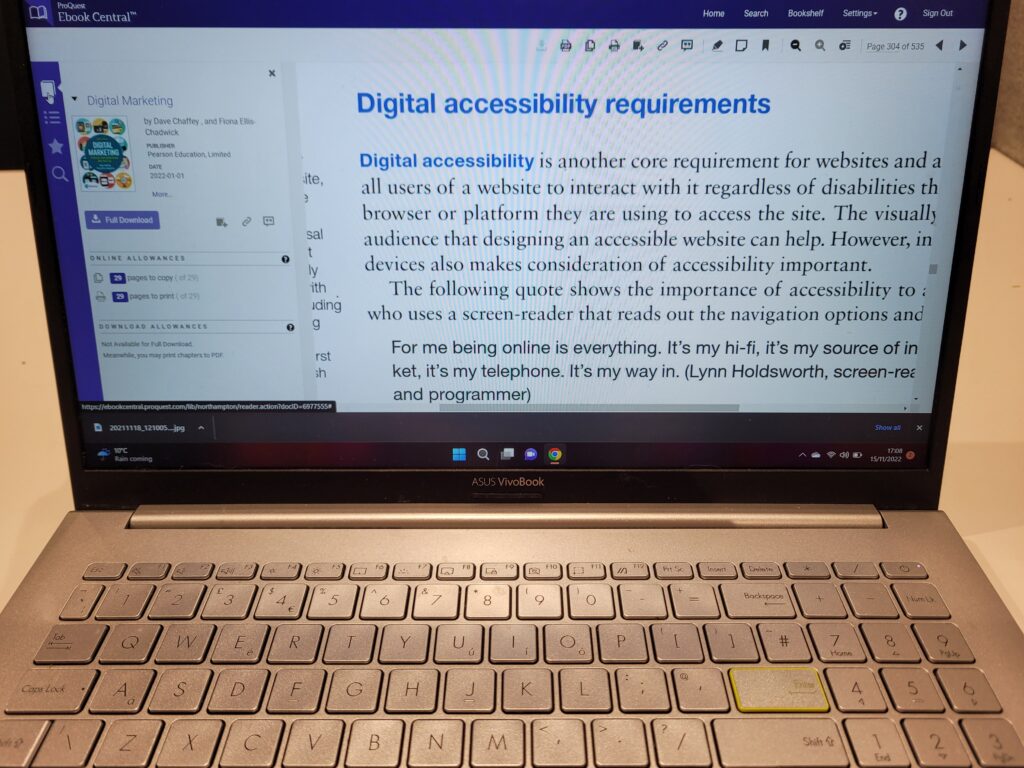
4. Digital materials / ebooks.
This one may be more specific to being partially sighted, although I find having access to digital copies of textbooks easier to read than a physical copy due to the fact that you can enlarge them to your desired size. I’m not sure if all Universities have this on offer, but students of Northampton have access to an online library, where we can access the core books for our modules for free online.
5. Look what clubs and societies are available.
Less academic related (as University is not just about studying at the end of the day), check out the range of clubs and societies that your Uni has on offer. There are probably things which you have never done before which you would find really interesting. They are also a great way of making friends with like minded people from other courses and year groups. I am part of the Equestrian club, and I have spoken about how the club and being able to get back into horse riding really helped me during my first year.
6. Don’t be afraid to make new friends aware of your disability.
I’m not 100% comfortable talking about my conditions to people. One reason being I just feel awkward talking about myself. Which I realise is also quite ironic considering I have a blog sharing my life experiences! Although I often fear that when speaking to someone, that I am sounding self centred, or looking for sympathy, something which is never my intention.
Explaining a medical condition you have, is not attention seeking. I encourage you to do it as it is something which I think can help eliminate “the elephant in the room” if your condition is visible to others. Now you do not need to disclose any details you don’t want to, however it can also help with friends getting an understanding of ways in which they can help you. For example, some close friends are aware that due to being deaf in my right ear, I find it easier if people stand on my left when we are talking. Additionally, when meeting up with a friend, it is good for them to be aware that they will see me much quicker than I will see them, or if someone sees me and I walk straight past, it isn’t that I am being rude, I simply did not see them.
7. Last but not least, be open minded and challenge your comfort zone.
University is a time for everyone to gain new experiences and you will encounter challenges along the way. For me, a big part of moving away from home to come study, was learning to get around a new large town. Living on campus in my first year was great, although I still needed to venture out to go shopping, meet friends at various bars / restaurants and so on.
I have admitted in past posts that I wasn’t overly independent or streetwise before moving away. However, I feel like I have accomplished quite a lot since coming to University and actively stretching my comfort zone.
I hope that you are able to apply some of these tips to your own situation.
Have a great day!
Becky. X


